 Skip to content

Breeding Worth (BW)
Is a tool used to identify animals that are genetically superior in converting feed to farmer profit.
It is an index that ranks animals for their expected ability to breed profitable, efficient replacements, based on ten economically important genetic traits.
BW is measured across all breeds and breed mixes, giving a single BW figure that allows direct comparison of animals regardless of breed.
By using BW, New Zealand farmers can track genetic gain in their herds year on year, and breed for improved production efficiency and profitability.
The index combines the Breeding Value (BV) of the genetic traits with the Economic Value (EV) of the traits to farm profit.
- Breeding Value (BV) tells us the animal’s genetic merit for that trait.
- Economic Value (EV) tells us what an improvement in that trait is worth to farm profit.
These are combined across all the traits using the below calculation:
BW = BV × EV
The result is $BW, expressed in New Zealand dollars relative to a genetic base cow of zero.
Higher-BW animals are expected to breed more profitable, efficient replacements. Over generations, selecting higher-BW animals drives genetic gain and helps build a more efficient and profitable herd.
Ten Traits included in BW
There are ten traits within Breeding Worth (BW) that are grouped as either production efficiency traits or robustness traits.
Production efficiency traits:
– Milk protein
– Milk fat
– Milk volume
– Liveweight
Robustness traits:
– Somatic cell score
– Fertility
– Gestation length
– Functional survival
– Body condition score
– Udder overall.
These traits are also relevant to dairy herds across the globe.
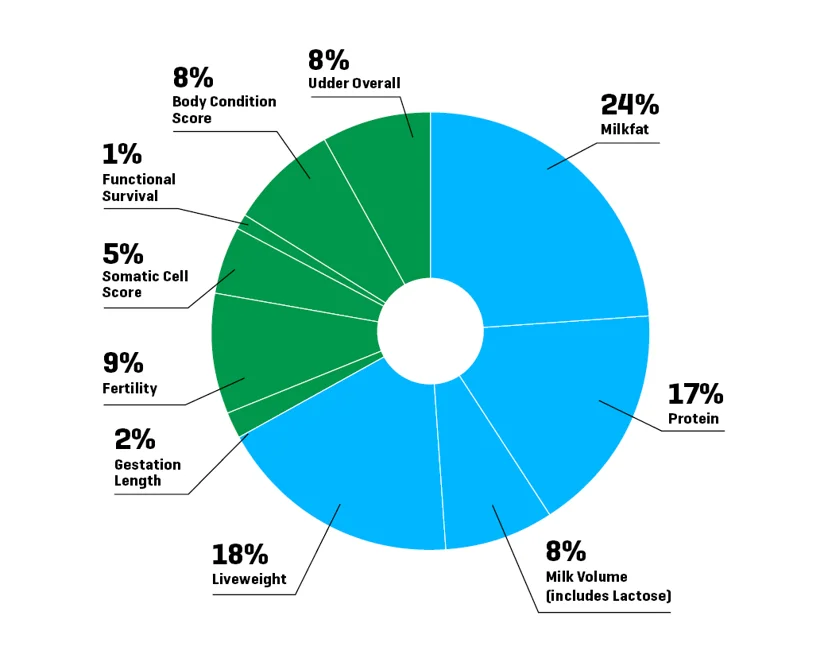
The effective emphasis of the individual traits within BW are split as per the pie chart below.
Find out more about traits included in Breeding Worth on the DairyNZ website.
Effect emphasis on the individual traits within BW pie graphs 2025
‘Traits Other than Production’ (TOP)
In addition to production and robustness, ‘Traits Other than Production’ (TOP) are also evaluated by NZAE.
It’s desirable to see genetic gain for other important non-production traits such a temperament, udders and dairy conformation. TOP traits cover these and fall into two main categories – management traits and conformation traits.
Management traits are farmer-scored and include:
– Adaptability to Milking
– Parlour Temperament
– Milking Speed
– Overall Opinion
Conformation traits are scored by trained inspectors and include:
– Stature
– Capacity
– Rump Angle
– Rump Width
– Rear Leg Set
– Udder Support
– Front Udder Attachment
– Rear Udder Attachment
– Front Teat Placement
– Rear Teat Placement
– Teat Length
– Udder Overall
– Dairy Conformation
Additional traits that are farmer reported include:
– Heifer Calving Difficulty
– Cow Calving Difficulty
Improving these traits helps build functional, easy-care herds with strong conformation.
Learn more about Traits Other than Production on the Breeding Values page of the DairyNZ website
Breeding Value (BV)
A Breeding Value (BV) estimates an animal’s potential to pass on its genetic merit to its offspring.
It is calculated using genetic data and performance records from the animal itself and from its relatives, including:
- Herd testing (milk recording) data
- Scale liveweight data
- Mating and calving records,
- Body condition scores
- Traits other than production (TOP) raw scores
Using breeding values to select the cows and bulls to produce the next generation is the most effective way to achieve genetic improvement.
For more information go to DairyNZ page on Breeding Values.
Economic Values (EV)
Economic Values (EV) are an estimate of the dollar value to a dairy farmer of a unit change in each trait.
This informs you how much a specific trait contributes to farm profitability. Breeding with this system helps dairy farmers improve profitable traits.
Economic values are based on the New Zealand costs and income sources relevant to each of the traits in BW. Economic values can be positive (reflecting a net profit to the farmer e.g. milk fat) or negative (reflecting a net cost to the farmer e.g. somatic cell score). Economic values are adjusted annually to ensure BW remains relevant in an ever-changing market environment.
For more information go to DairyNZ page on Economic Values.
Genetic Reliability
This indicates the confidence that an animal’s breeding value and breeding worth reflects its true genetic merit.
Sitting alongside the Breeding Worth (BW) figure, the reliability figure is reported on a scale of 0 to 100%.
The higher the reliability percentage, the more confidence farmers can have in the BW figure, and the smaller the movements will be as more data becomes available.
For more information on Genetic Reliability visit the DairyNZ website.
Genetic Base Cow
Animals are ranked for BV or BW relative to a ‘Genetic Base Cow’ reference point of zero.
If an animal is more profitable than the genetic base cow, the BW value will be positive. If less profitable, the BW value will be negative.
The genetic base cow consists of a group of well-recorded cows from a specific year. Their BW profit index and BVs set the zero point against which all other animals are compared.
Because the genetic base cow for NZ includes a mix of breeds, for some traits the value may be negative e.g. Jersey animals usually have a negative liveweight BV because they are generally smaller than the genetic base cow.
The genetic base cow is regularly updated, typically 5-yearly. Updating the genetic base cow ensures that genetic progress is accurately reflected and it keeps the genetic base cow relevant to the current population. Updating the genetic base cow is common global practice in modern dairy genetic evaluation systems.
Genetic Gain
The genetic merit of a population should continually improve in a successful breeding programme.
Breeders use genetically elite animals in every new generation to advance the population average BW. This is called genetic gain and tracked in genetic trend graphs. Genetic trends are favourable in the New Zealand national herd.
For up-to-date graphs showing genetic trends view the DairyNZ website.
The benefits of this genetic gain include improved herd performance and more sustainable farming with reduced emissions intensity.