Breeding for Tomorrow: Faster, Smarter, Sustainable

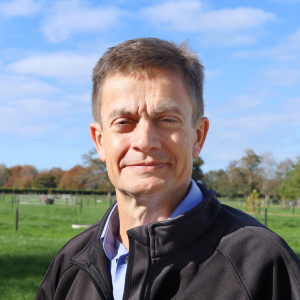
Since joining LIC last year, time has flown by, as I’ve met with customers and collaborated with the team to explore how we can become even more relevant to farmers maximising and optimising their milk from grass.

James Simpson - LIC Europe General ManagerBy James Simpson, General Manager, LIC Europe

It’s great to see how our genetics are making a difference on farm. Time and again, herd data shows a clear advantage for LIC pasture-based dairy genetics in efficiency metrics of kg milk solids per kg liveweight and per hectare.

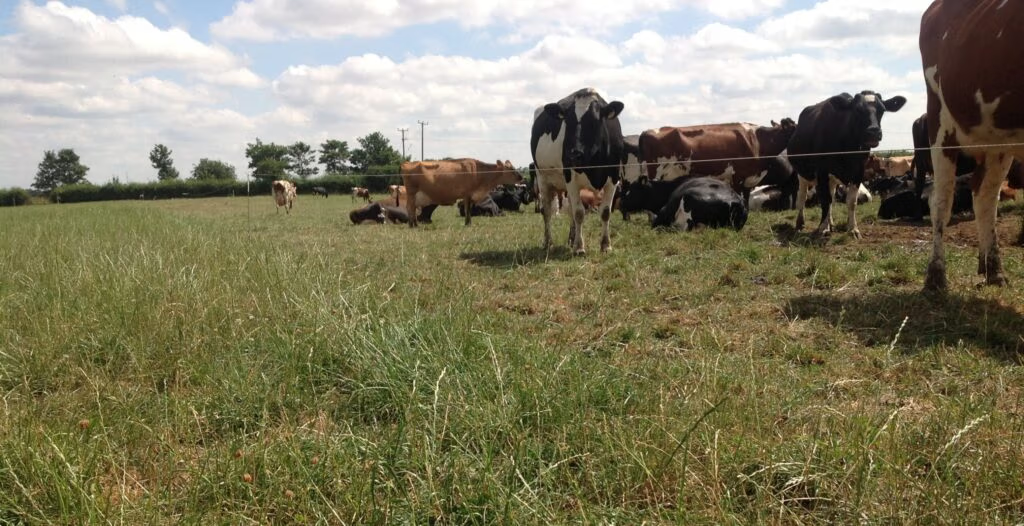
I grew up on a tenanted farm in the Midlands of UK, milking Friesians in a pasture system where clay soil stuck to your boots and was impossible to remove without a power washer.

My previous company represented LIC for a number of years in the 1990s and my role at that time involved selecting LIC bulls such as Judds Admiral (in the background of current bulls such as Paynes Stamina) and Dawson’s Belvedere (ancestor of Scotts BV Darius) for the UK market.

Over the past 15 years, I’ve spent the majority of my time travelling to farms, meeting customers and distributors of genetics in over 35 countries across Europe, Africa and Asia. Throughout this time, I was consistently drawn to the cow that produces more from less – typically a smaller animal utilising cheaper and usually more abundant resources to produce nutrient rich food.

I’ve always admired the pioneers – some of them family and friends – who chose the milk-from-grass path to weather the turbulence of milk prices from the 1990s onwards. This approach allowed them to minimise losses during tough times while retaining the flexibility to feed concentrate when the milk-to-feed price ratio was stronger. Today, as consumer focus shifts to carbon footprint, the advantage of grazed grass is becoming even more apparent thanks to the work from Moorepark and others.

From a genetic planning perspective, the fundamentals remain the same:

  1. What do you want to change about your cows?
  2. How much do you want to change it?
  3. How fast do you want to make that change?
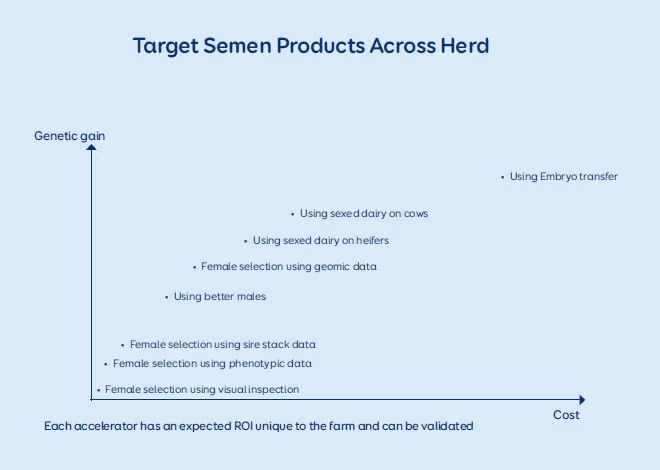
The speed of change you aim for involves a trade-off, both with fertility (an opportunity cost) and the cash cost unique to your situation. That’s why it is crucial that all the information and tools are available to determine the right approach for your herd. We hope this provides the right balance of information and clarity. If not, please let us know so we can work on improving this. The diagram below illustrates some of the ways to go faster while highlighting the cost.

We too are exploring options in the genomic female selection space.

We have observed this as a tool that can help rapidly accelerate genetic progress while breeding from the top 40% of the herd (median cow is No. 20 out of every 100 ranked, as opposed to No. 50 without any female ranking).

Moving to male selection, if you look back at the 2022 directory and compare the six highest genomic bulls with the six highest daughter proven bulls, the results are striking. Today, the average proof of the top six daughter- proven bulls is $216 BW, while the top six genomic bulls average $245 BW, showing how genomics accelerates genetic improvement.

It’s important to spread risk and balance this against practical constraints. My favourite definition of a team is a group of people with complementary strengths and trust, working together towards a common goal – a principle I aspire to in all aspects of business, sport, and life. In genetics and specifically sire selection, this concept also applies: there is a formula for team reliability.

Group reliability = 100% – (100% – average group reliability) ÷ number of bulls selected. This means 4 x 60% reliability bulls = 1 x 90% reliability bull.

This is something worth optimising for your situation.

The cow herself can show us which animal best suits the system. Every farm is unique, and when heifers walk into the parlour, it’s an excellent opportunity to see if we are on track, before validating the genetic plan with performance data and seeing who thrives and who merely survives.

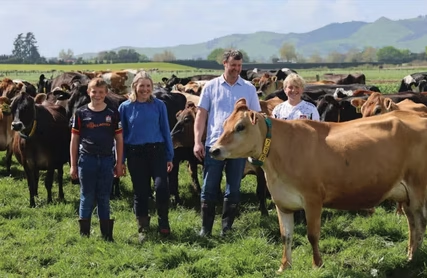
We believe KiwiCross® bulls deliver more than the sum of its parts. By combining the ferocious grazing appetite of Jersey genetics – achieving higher dry matter intake per kilogram of bodyweight and outstanding milk quality – with the proven production capability of the Holstein Friesian, we create a powerful combination on farm in the UK, Ireland, New Zealand and many other countries.

Collaborating with Cogent in the UK allows us to combine our expertise and leverage each other’s strengths. By combining LIC’s expertise in grassland genetics and systems with the operational excellence in sales, service and support capability of Cogent, we can deliver even greater value. With Cogent’s parent company, ST Genetics consistently providing the reproductive quality of our sexed semen and working closely with LIC colleagues at the EU centre in Awahuri, this collaboration enables both organisations to focus on their strengths – working together seamlessly across Northern and Southern Hemispheres.

What does this mean for you as a customer or potential customer of LIC?

It reflects our unwavering commitment to accelerating genetic improvement in your herd, tailored to your needs. For those focused on maximising milk solids per hectare within low-cost, pasture-based systems, this means enhancing productivity without compromising fertility. For operations optimising concentrate feeding and managing slightly higher fixed costs, it translates into driving greater volume per cow.

by Michelle Lamerton
International Marketing Coordinator
Share this:
Related content for you
Login to LIC
Are you sure you want to log out?