Skip to content

The value of a day in milk
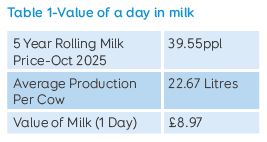 Days in milk has long been a key focus in block calving systems, maximising days in milk by driving fertility improvement to increase revenue. Table 1 shows the current value of a lost day in milk, based on the current 5 year rolling average milk price from October 2025.
The value per cow per day is calculated using average yields from the top 53% of animals across 123 herds in the LIC UK database, with an average lactation yield of 5,858 litres. This figure reflects a true value, since the loss of milk would be seen on those served to sexed semen which requires the top 53% of a herd. A day in milk holds significant value for any dairy business, making fertility a critical performance driver – yet this is only half of the story.
Value of selection intensity
The other half of the story lies in the value of selection intensity, which is one of the key advantages of using sexed semen. This benefit comes from enabling farmers to breed from the best animals in their herd. With sexed semen, selecting the top 53% of a herd typically provides enough dairy replacements in a given year. In contrast, using conventional semen would require selecting the top 90% to achieve the same result, assuming all dairy semen is used during the first three weeks of the service period.
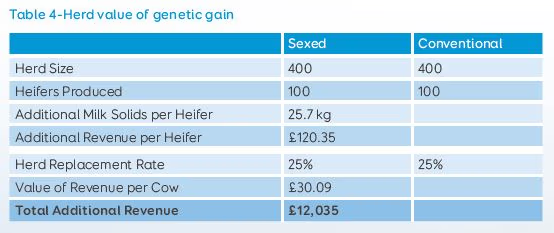
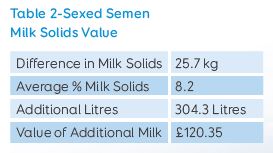 Exploring the performance gap between the top 53% and top 90% of the herd is critical. By using the data from the herds mentioned previously, the average difference in production between the top 53% and top 90% is 51.4 kg milk solids. Based on BV’s (Breeding Values) we can assume animals pass on half of this advantage, giving a benefit of 25.7 kg milk solids. Table 2 shows the value of this benefit per heifer born.
The comparison
Block farmers’ reservations about sexed semen often stem from concerns over reduced conception rates. However, several studies have examined the differences. One of the most relevant and current pieces of research was conducted by Teagasc in 2018, showing an average conception rate difference of 10.5%. However, within this there was no pre-selection of cows, even though younger animals generally have a higher chance of conceiving with sexed semen. Other trials have reported smaller differences of 5% shown in a meta-analysis conducted by ICBF in 2022, whilst a German trial conducted by Lenz et.al. (2016) showed no difference in conception rates.
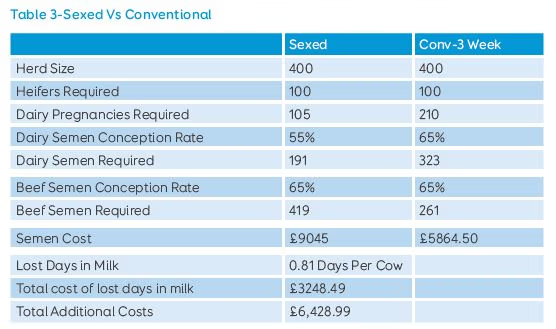
Applying this to a herd setting, if we take a 400-cow herd moving from conventional to sexed semen, we can calculate the days in milk lost due to the use of sexed across the herd. Table 3 compares sexed vs conventional semen, based on expected usage in both scenarios. The calculation assumes service from week 1 to week 12 of a 12-week block, without the use of stock bulls with all dairy semen, used within the first 3 weeks to generate the required replacements.